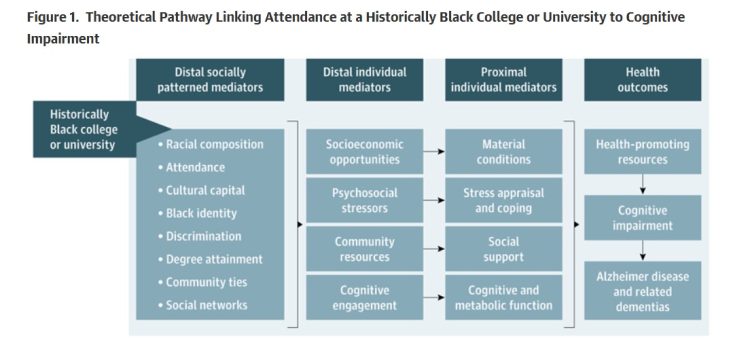
Attending an HBCU may provide long-term positive mental health benefits for Black Americans, according to new research.
The study, published last month in JAMA Network Open, examined data from 1,978 Black adults who attended college between 1940 and 1980.
Researchers found that Black adults who attended an HBCU had better memory and cognitive functioning by age 62 compared to peers who attended predominantly white institutions, according to The Guardian.
“This suggests that culturally affirming college environments may have lasting effects on brain health,” Dr. Marilyn Thomas, the study’s lead author and an assistant professor of medicine at the University of California, San Francisco, told The Guardian.
What was the study’s methodology?
Thomas’s team analyzed how exposure to “state-sanctioned racialized education policies” during formative years influenced long-term outcomes.
The study, conducted with co-authors from Rutgers, Alabama–Birmingham, Columbia, Boston University, and Harvard, examined differences between students who attended college during segregation and those who came after its end.
Thomas found that HBCU attendees often had meaningful early life support systems. They were more likely to have mothers or female caregivers with college experience and to report receiving affection during childhood.
“Those early experiences, combined with the nurturing and affirming culture at HBCUs, may contribute to a lifetime of resilience,” Thomas said.
Her earlier research has traced how chronic exposure to racism can lead to worse health outcomes, from hypertension to accelerated aging. Education, she noted, can help buffer those effects.
What HBCU study means
Unlike many cognitive health studies that focus on years of schooling, this one centered on the environment itself — asking whether any time spent at an HBCU influences brain health decades later.

“Our question was, ‘Is any exposure to an HBCU going to have a later-life impact on your cognition?’” Thomas said. “And the answer was yes.”
Thomas described the study as exploratory but emphasized that it contributes to a growing body of evidence suggesting culturally affirming educational spaces can have lifelong benefits.
“What’s powerful about this finding is that the benefits of attending an HBCU last well beyond graduation,” she said. “These are adults in their 60s, and we’re still seeing the positive effects.”
Many historically Black colleges and universities have reported significant increases, and some have achieved a record number of enrolled students, according to The Journal of Blacks in Higher Education.