FCS conference realignment is reshaping the landscape of the subdivision, particularly after football power North Dakota State agreed to make the FBS jump.
The ripple effect will be wide when the changes officially take place on July 1, with eight of the 13 FCS leagues undergoing some form of change and the national lineup projected to settle at roughly 127 or 128 FCS programs by the start of the 2026 season.
These shifts will have some impact on three HBCU programs — North Carolina A&T, Hampton and Tennessee State — with implications for travel, recruiting, scheduling, and their long-term paths to contention.
North Carolina A&T: CAA road gets no easier
With Sacred Heart set to join CAA Football in 2026, North Carolina A&T remains in a 13-team league that still demands weekly physical, playoff-caliber football even after the departures of Villanova and William & Mary.

From a competitive standpoint, the addition of Sacred Heart offsets some of the brand power lost with Villanova and William & Mary. But it does not fundamentally soften the league for A&T.
N.C. A&T, which is coming off its third consecutive 10-loss season, has been trying to find its footing since moving from the MEAC through the Big South.
The challenge remains the same: climb a crowded middle tier in a league that still expects to send multiple teams to the FCS playoffs each season.
Hampton: depth, travel and a longer climb
Hampton’s situation mirrors North Carolina A&T’s in many ways, but with fewer historic CAA footholds to lean on. The Pirates remain part of the 13-team CAA lineup in 2026, navigating the same expanded, northern-tilted footprint.
For Hampton, Sacred Heart’s arrival adds another Northeast opponent that could become a natural scheduling partner but also another program fighting for the same middle-of-the-pack oxygen the Pirates are seeking. In the short term, that means Hampton’s climb toward a contender does not get much easier; the pathway still runs through a gauntlet.

Where realignment may help Hampton is in branding. The CAA’s continued stability at 13 programs in 2026 allows the school to sell recruits and donors on staying in a “power” FCS league rather than being caught in a shrinking conference or alliance.
Tennessee State: more isolated in the OVC–Big South setup
While A&T and Hampton are trying to survive in a deep CAA, Tennessee State is watching its own neighborhood change around the OVC–Big South Football Association.
Tennessee Tech’s move to the Southern Conference in 2026 removes a familiar in-state foe and long-time OVC member, leaving the OVC–Big South football group at eight programs.
For TSU, that translates to fewer natural regional games and the loss of an easy-marketed in-state conference matchup, even as it maintains its traditional HBCU rivalries outside league play.
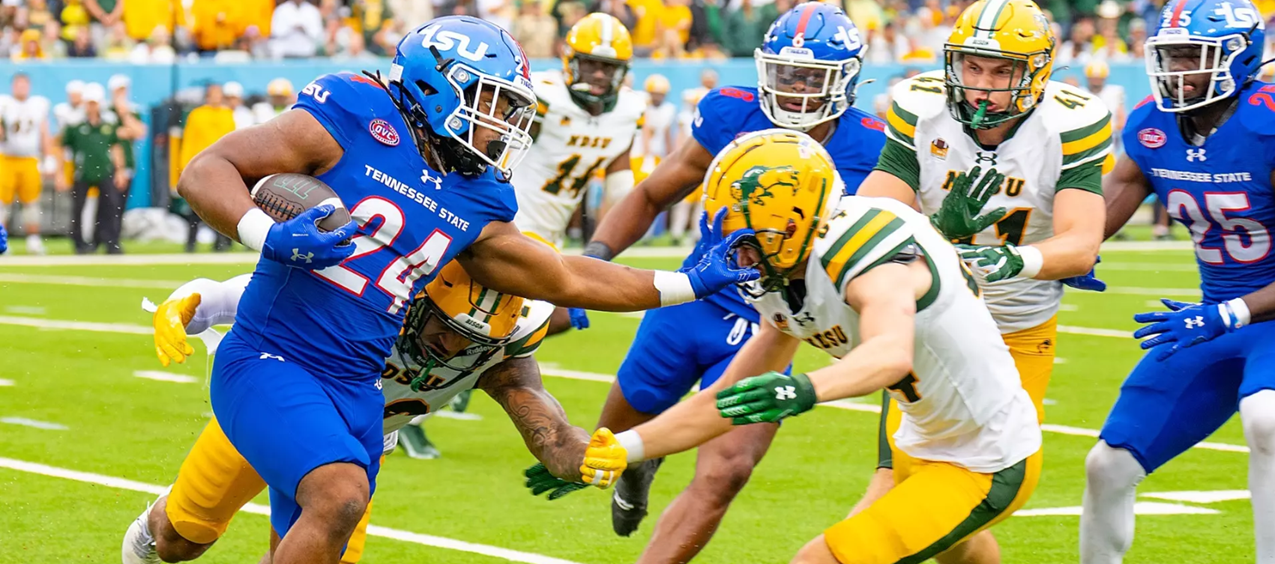
It may justify why TSU has gone HBCU-heavy in its non-conference schedule in recent years.
On the field, the OVC–Big South partnership still offers Tennessee State a clearer path to an automatic playoff bid than a crowded league like the CAA, simply because of its smaller membership and less top-heavy profile.
The Tigers did make a trip to the FCS postseason in 2024.
But with Tennessee Tech leaving and no immediate replacement of a similar regional profile, TSU’s situation underscores a familiar question: does it make more sense long term to seek a different conference alignment that better matches its HBCU identity and geography, or to try to become the flagship program within a more eclectic association?
Some HBCU football fans want Tennessee State to make the transition to either the SWAC or MEAC, identifying it as a national cultural fit.
For now, the realignment wave cuts in different directions: A&T and Hampton stay in a deep, tough conference, while Tennessee State remains in an alliance that is stable enough for playoff access but increasingly thin on regional clarity.