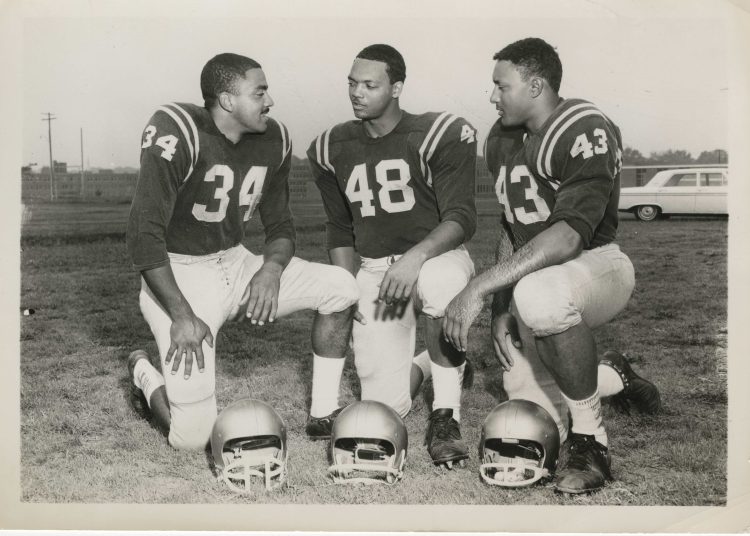
Before Jesse Jackson led marches, delivered speeches, and built coalitions on the national stage to fight injustice, he suited up as an HBCU football player.
Jackson, who died this week at 84, called plays, dodged tacklers, and learned lessons at North Carolina A&T.
Jackson arrived at A&T in 1961, transferring from the University of Illinois after one year on scholarship. He had entered the Big Ten with ambition and talent, but also into an environment unwelcoming to Black quarterbacks. “There was a real hostile racial atmosphere,” Jackson later recalled as reported by The Washington Post. “I was determined to play quarterback or play nothing.”
Greensboro, still fueled by the energy of the 1960 Woolworth’s sit-ins, offered Jackson a new beginning. At A&T, football and the fight for civil rights often shared the same field. Jackson joined the Aggies in 1962, though his initial contributions came on defense as an end, occasionally seeing time at fullback on a team that would win the CIAA in 1964.
The following spring, his leadership off the field began to match his presence on it. Jackson was elected president of the student government, and by May 1963, he was helping organize demonstrations pushing for equality in Greensboro. That summer, he was charged with inciting a riot — a case that was dismissed for lack of evidence.

Yet even amid activism, Jackson never fully left football behind. In the fall of 1963, he returned to quarterback — his natural position — sharing duties with Cornell Gordon, a versatile athlete who would later play in the NFL. Despite the pairing, Jackson made his mark. In a 60–18 rout of Winston-Salem State, he threw two touchdown passes — one for 49 yards, another for 23 — both to Gordon.
The duality of Jackson’s life at A&T — athlete and protest leader — reflected a moment when sport and social struggle often intersected. On campus, he helped mobilize fellow students and sharpen his organizing skills.
“I learned a lot that year, athletically and academically,” Jackson said later. “It was my chance at broader expression.”
Though his playing career at A&T ended without eye-popping statistics, Jackson’s leadership — both as a quarterback and as a campus activist — became the foundation for what would follow. He was later inducted into the North Carolina A&T Sports Hall of Fame in 1984.
For many, Jackson’s story as an athlete is a forgotten footnote in his larger legacy. But those who knew him at A&T saw the connection clearly. Jesse Jackson learned to lead in huddles before he led in marches — player who would one day call audibles for social change.