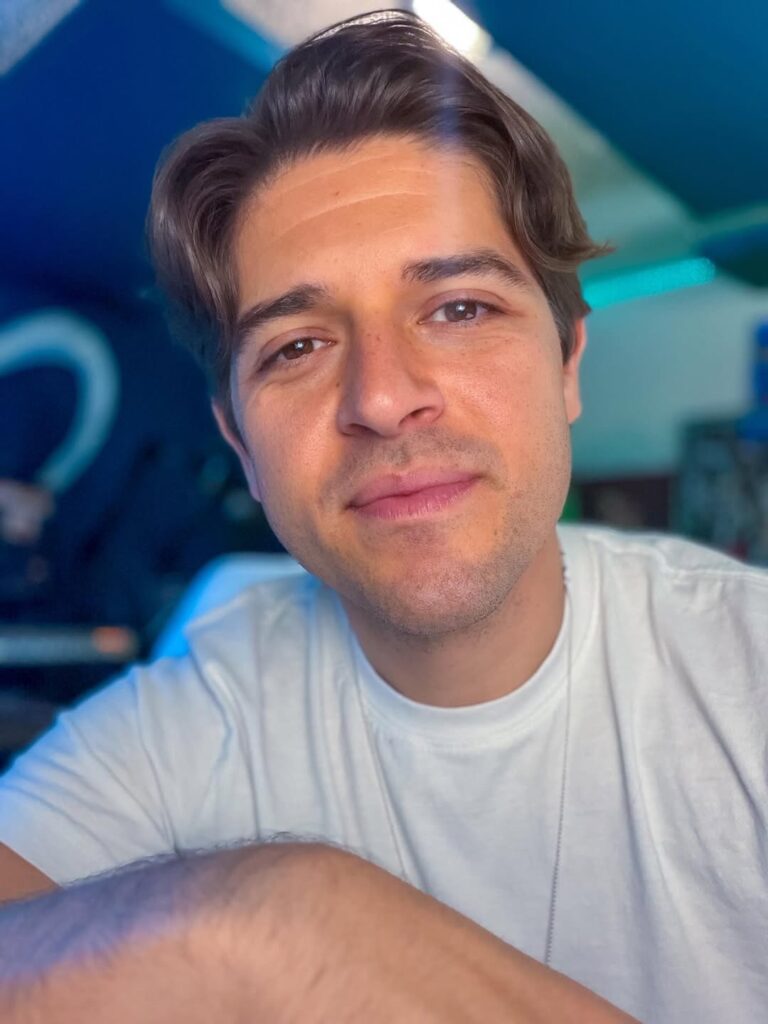
Paul Castro Jr. has been working to build a career that ranges from a rainy fight scene for network TV to a controlled dub for anime, and he finds that the link is the same skill he developed back in New York.
Recently, on the Wayne Ayers Podcast, the actor and voice actor took host Wayne Ayers through his journey, which led him from a pre-med track in New Jersey to New York Univerpre-meddrama program and finally to his voiceover work, which currently includes the weekly release of Twisted Wonderland: The Animation for Disney, The Summer Hikaru Died for Netflix, Dragon Ball Daima, and Yu-Gi-Oh! Go Rush.
Castro begins by pointing out the work environment in his home studio, in which he does a large portion of his recording work.
“That’s where I do most of my recording,” he pointed out, mentioning that he uses another area for streaming. “I’d say like a quarter of the stuff that I do in this studio here,” he replied.
There are comforts and real trade-offs involved in remote recording, he observed.
“When I’m there, I can, you know, do it in a T-shirt and shorts,” Castro said. It’s also the stimulation of being with other people in a professional setting, though he understood the reality of commuting. “When you go to the studio, sometimes you’re sitting in an hour of traffic, depending on where it is. So, you know, pros and cons to each of them.”
From pre-med to stage training to TV in NYC
Castro spent his childhoodpre-med York before his family relocated to New Jersey, where he enrolled at Monmouth University. He had initially thought he would become a doctor.
“So, I started in biology, doing some pre-med work,” he said. “And then I realized ppre-medquickly that I hated it.”
He ended up finding a home in the theater department, changing majors, then double-majoring in communications and theater. The communications part of his education gave him insight into the entire filmmaking process, as well as skills he still uses to this day.
“Double-majoring in communications allowed me to take a class in video editing. It allowed me to take a class in radio broadcasting,” Castro said. Castro said he learned Adobe software, including programs he uses daily. Castro hosted a show on the radio and was involved with the TV network at his school.
This feeds directly into his present-day life as a performer and a filmmaker.
“My wife and I, we just made a movie that we co-directed, produced, and wrote,” Castro said. “So, while a lot of people know me from my voiceover work, I think it definitely gave me a background to be a filmmaker or a storyteller.”
He later attended New York University’s Meisner studio for almost three years before beginning to take theater, television, and film roles in New York. He acted in Law & Order and Blue Bloods.
Law & Order was a rite of passage.
“‘That’s like the gateway into TV and film acting,” he said, adding it’s a badge of honor to earn his stripes with the franchise that has been around for so long.”
Blue Bloods was an experience in learning how quickly things can shift in a scene. Castro remembers filming a night scene in a park that was not indicated in the script as a wet night, but upon arrival, he found it was.
“When we got to film, it was pouring rain,” he explained. “So I’m slipping and sliding and getting thrown on my back and all that.”
Nickelodeon promotions and foray into animation
Even when he was on camera, Castro had his sights set on voiceover work, thanks to his lifelong love of anime, animation, and video games. Castro encouraged his agents to seek work in the voiceover industry, which is best known for commercial work.
This hustle paid my rent, too.
“That’s how I was paying my rent when I was living in New York,” said Castro about his work with Nickelodeon, doing promo bumpers and spots for Nick Sports, including “NFL Rush Zone.”
These opportunities gave him a glimpse of a career in voice acting, then led to further opportunities in a series for Nick Jr.’s Nella the Princess Knight, a project for PBS that was not ultimately broadcast, and finally to voice Clifford in Clifford the Big Red Dog.
Castro also attributed the early growth of his voiceover business to the New York studio scene and to working with directors associated with big franchise brands. Castro then chose to “take things more seriously” by relocating to Los Angeles.
In the LA region, he changed his career path when he landed the role of Neo in The World Ends With You, which he believes marked the beginning of his current career phase.
On-camera acting versus Voiceover work.
Castro explained to Ayers that the process and performance for live-action and voiceover are quite different because the actor must connect with something physical.
“Because you’re doing it live, you’re basically memorizing the lines,” he said, talking about the importance of being present with a partner while acting out a scene.
Voiceover can be the opposite. “We often aren’t required to memorize the lines, and your script’s right in front of you the whole time. A lot of times, you’re seeing the script for the first time.”
Still, he does his best to apply the same professionalism to the commentary box.
“If I receive a script for auditioning, I attempt to memorize as much of it as possible,” he said.
The main difference, of course, is the lack of another human being to interact with.
“The wall in front of me becomes my scene partner,” he continued. “And then I find myself imagining the whole world that I’m in is all happening in that little booth behind me,” he added.
In live-action auditions, his wife often serves as his reader, providing him with eye contact and emotional feedback necessary for voiceover acting.
“Divine Blood,” independent cinema, and the struggle for original content
Castro and his wife, Alli Miller, co-directed and produced their first feature film, Divine Blood, described by Castro as a “dark comedy about a menstrual artist experiencing menopause and identity crises.”
“It features Lena Headey from Game of Thrones and Robin Tunney from The Mentalist and The Craft,” he said, adding that the movie took a month to shoot in the upstate region of New York around the areas of Newburgh and Beacon.
It was both personal and industry-related for Castro.
“It’s a movie about self-worth as an artist, what it’s like to be a female in a male-dominated area of the arts,” he explained, of what he said was a mentorship relationship between Miller’s character and Headey’s, as well as two different strains of feminism represented by those relationships.
However, he praised Headey’s openness to work with first-time directors on a feature.
“‘The fact that she had so much trust in us to make this movie as a first-time filmmaker,” he said, adding that she added “humor and depth to a role that I think is going to surprise people.” “She’s amazing,” he said. “My gosh.”
The team is not making any announcements about the festival plans yet, but they hope to do so soon. If he could choose the distribution method, he would want both theater and streaming distribution.
“I’d love for us to do a theatrical run, even if it’s a limited one,” he said, then partner with a streamer afterwards. He cited A24 and Neon as examples of good platforms for indie content.
For Castro, the lesson is survival, not sentiment. Raising funds for original content is “insane,” and the drive for recognizable franchises is making it harder to get new IPs off the ground.
“I’m completely fine with reboots or sequels,” he said, adding he likes remakes such as Final Fantasy VII. However, he emphasizes the need to accommodate both in terms of audience demand and delivery by studios. “The problem is when we just concentrate on … doing Shrek 1, 2, 3, 4, 5, 6, 7, 8, 9, 10 and not look for other stories.”
Dragon Ball, fan questions, and an AI warning
The Dragon Ball series is Castro’s genuine passion, and being part of Dragon Ball Daima as Mini Vegeta was not something Castro anticipated. He discussed growing up from a teen Gohan fan to a Vegeta fan, particularly Majin Vegeta.
“Personally, I never thought that in my wildest dreams that I would have the opportunity to take on a role such as Vegeta,” he continued, attributing this to the direction given by Jonathan Rigg and the need to pay homage to what has come before.
He also spoke about the use of AI in film and gaming, terming it “very concerning” for actors. He called upon fans to support human storytelling.
“‘I don’t think this should replace us,’” he said about artificial intelligence. “‘It can be a tool we use, but it can’t replace.’”
In a flurry of fan questions, Castro identified the most surreal experience of his career as being cast as the lead in Neo: The World Ends With You and mentioned other work, such as voicing Final Fantasy VII and Dragon Ball. Castro’s dream role as a villain would be based on a version of the Joker, and he mentioned being interested in playing a young Sephiroth.
He also shared an unexpected sports-related activity he pursued before becoming an actor. He pole vaulted in high school. “Pole vaulting, I grew up doing,” he said. “Being a short guy, I was kind of a little cannonball.” As for what is to come, Castro teased upcoming projects but was not allowed to discuss further due to nondisclosure agreements. Castro was quick to point fans to other projects currently on air. “Twisted Wonderland comes out every week,” he said.
In addition to that, “The Summer Hikaru Died is on Netflix. Yu-Gi-Oh! Go Rush continues to be released weekly. But then, with the warm, candid atmosphere that makes the podcast feel so much like a conversation, Castro ended with this simple yet powerful thought: “I want both worlds: the franchise worlds that raised me, and the original ideas that could shape the future.”
The post Paul Castro Jr. Opens Up on The Wayne Ayers Podcast: “I Never Thought I’d Voice Vegeta” appeared first on Where Is The Buzz | Breaking News, Entertainment, Exclusive Interviews & More.