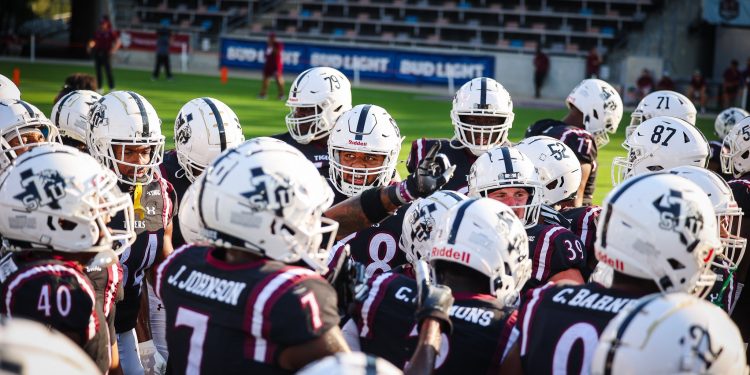
Texas Southern head football coach Cris Dishman voiced strong frustration this week over what he described as a growing issue of unqualified “street agents” attempting to lure his players away.
Dishman said the problem has worsened as individuals posing as agents approach young players with false promises and unethical financial demands.
“I call them street agents,” Dishman said Monday during the SWAC coaches virtual press conference. “They’re not real agents. We already have these fake agents out here poaching our kids. It’s a shame that we allow that—not just as a university, but as the NCAA. These people are poaching our kids already.”
The NCAA Division I Cabinet formally approved a significant change to the transfer portal process in October, establishing a single offseason transfer portal window for FBS and FCS players from Jan. 2-16, 2026, and eliminating the spring portal window in April.
But that hasn’t stopped agents from circumventing it, says Dishman, the Tigers’ second-year coach.
It is a process, Dishman says, that is predatory for some players who haven’t established themselves to the level that they would even need an agent.

‘Everybody wants to be an agent’
“You can’t have an 18- or 19-year-old kid talking about he has an agent,” he said. “You haven’t even lived life to have an agent.”
Coaches and staff members are prohibited from contacting any player who has not yet formally entered the transfer portal, but there are no rules against contact with agents.
Dishman also criticized the financial exploitation behind the agents’ tactics, claiming that some of them charge players 18 to 20 percent “for doing nothing but sitting at home making calls.” He said those practices divert attention from education and athletic development.
Industry experts say that number can reach as high as 15%, especially for FCS-level players who may not generate as much attention on their own in the transfer portal, according to an ESPN report.
“That’s the frustrating thing about coaching these days,” Dishman continued. “Everybody wants to be an agent, but nobody wants to work or go get a degree to be one.”
To combat the issue, Dishman urged players and families to rely on trusted advisors rather than outsiders with questionable motives.
“We have to educate our young men,” he said. “Don’t listen to these people trying to be street agents. Talk with your family, your high school coach—someone who can give you real advice, not what these poachers are selling.”
Lawmakers get involved in agent, NIL regulation
A group of Senate Democrats introduced legislation in September to bring federal oversight to the increasingly chaotic NIL landscape in college athletics.
Known as the Student Athlete Fairness and Enforcement (SAFE) Act, this legislation tackles multiple pressure points simultaneously: NIL compensation, media rights consolidation, athlete welfare, and the preservation of Olympic and women’s sports programs.
Additionally, the bill would include agent regulation, where athlete agents would face a 5 percent fee cap and be subject to state registration requirements.
Dishman’s comments reflect a growing concern among college coaches nationwide as the line between amateur and professional representation continues to blur in the era of NIL deals and the transfer portal.